Monday, February 22, 2016

10 DINOSAURS RANKED IN ORDER OF HOW PAINFUL IT IS WHEN YOU STAND ON THEIR PLASTIC COUNTERPARTS IN THE NIGHT


 10. Pachycephalosaurus
Pachycephalosaurus, meaning “thick-headed lizard”, roamed between 66 and 72 million years ago, and is known for its distinctive bony cranium, which is only marginally painful when pressing into the arch of your foot as you stagger zombie-like into your child’s room to find out why they aren’t asleep yet.   


9. Tyrannosaurus Rex
A gigantic carnivore weighing up to 6.8 metric tonnes, the Tyrannosaurus Rex (“Tyrant lizard”) is still an absolute pleasure to stand on compared to some of the others on this list. Unless you somehow manage to stand on its erect tail, in which case it can pierce flesh like a needle, if that needle was made of possibly toxic material in a Chinese toy factory.


8. Diplodocus
The most famous of the sauropod family, Diplodocus lived in what is now North America at the end of the Jurassic period, and is one of the most common obstacles encountered when answering your child’s piteous nocturnal pleas. Diplodocus could grow up to 25 metres long, almost as if it was deliberately reaching out to trip you down a flight of stairs with its whip-like tail.


 7. Revvit
A fictional creature from the hit Netflix show Dinotrux, Revvit combines the pain of standing on a prehistoric lizard with the pain of standing on a box of drill bits.


6. Dimetrodon
Though technically a non-mammalian synapsid rather than a dinosaur, Dimetrodon merits mention on this list because of the large sail on its back, which was likely used to regulate the creature’s body temperature and feels like stepping on a saw blade when stumbled upon during nighttime bathroom trips.


5. Pteranadon
Also not a dinosaur. Also, I don’t care because when that cranial crest is caught between your toes as you’re reaching for the Vicks and you’re sobbing softly under your breath so as not to wake your sick child, you won’t see the distinction either. Fie upon you, Pteranadon!


4. Triceratops
“Three-horned face”. It seems like a no-brainer that this 9 metre long herbivore would make this list. Those same fierce horns that did battle with Tyrannosaurus Rex are now doing battle with your ingrown toenail. And they’re winning, by God, they are winning.


 3. Styracosaurus
Just look at these deformed bastards. Styracosaurus literally means “spiked lizard”. No shit, Sherlock. It looks like someone took a Triceratops and instructed Rob Liefield to give it an "xtreme" makeover. Holy shit. Just holy shit. Its head is literally exploding with spikes. The only upside to the Styracosaurus is that it is one of the less common dinosaur toys. I’m pretty sure my son has never heard of it, and I see no reason to tell him. Consequently, Styracosaurus never quite achieves the threat level of the last two malefactors on our list.


2. Ankylosaurus
Ankylosaurus is “Fused lizard” in Latin but really, it might as well be “weaponised hell-turtle footkiller”. It looks like a pincushion with legs and a bad attitude. Those bone knobs on the shell are known as osteoderms, but I like to call them “agony-lumps”. Ankylosaurus is one of those dinosaurs that might “accidentally” find its way into the garbage after one too many encounters with unsuspecting feet, if only that didn’t mark you out as a singularly awful human being. Go on, think about throwing it out. Think of your child’s tearful face when he or she can’t find their beloved ankylosaurus, you irredeemable shit.

Why do you hate me, Jesus? Why do you hate my feet?


1. Stegosaurus
The humble Stegosaurus may have had a comically small brain, but whatever malignant God cursed it to live pushed the ‘spikiness’ dial up to 11 to compensate. Stegosaurus seems to have been designed to be so deliberately, maliciously painful to stand on, it either proves or disproves the theory of evolution – I can’t decide which. It is appallingly sharp no matter which way you stand on it. Its set of four tail spikes (known as a “thagomizer”) has the capacity to pierce the skin of even the most calloused of feet. Its 17 to 22 defensive plates form a ridge across its back the merest tickle of which is akin to getting your foot stuck in a lathe. My son could not create a more painful trap for me if he dug a punji pit in the centre of his bedroom and baited it with beer and pork crackling. 

Purely from a design perspective, Stegosaurus is the clear winner here when it comes to permanently damaging the feet of careless parents when they chance to step out of the designated "clean" area of any child's bedroom. It looks like it was designed by the Spanish Inquisition to torture heretics. I’m certain there is a layer of hell in which sinners are forced to walk on Stegosauruses for all time. It is the perfect organism for inspiring a toy with which to mangle a man’s foot. I almost admire it.

Tuesday, January 19, 2016

Batman, Bickle, Trump and Bundy – Why we need to say goodbye to the Lone Avenger narrative


Netflix's Daredevil

After abandoning it the first time round, I finally managed to catch another episode of Daredevil last night. Late to the party, I know.

It’s made me think, though, about the concept of heroism. Every story needs a hero. It’s the one thing you can’t do without, be it a novel, TV show or movie. Stories sink or swim on the weight of their protagonists. Does Daredevil succeed in this regard? Well, granted I’m only four episodes in, but I can’t say it provides any compelling reason for me to continue to follow Matt Murdock’s one-man crusade against crime.

The fact is, Matt’s a pretty boring protagonist, straight from crusading lone-wolf central casting, and giving a second chance to Daredevil has pretty much confirmed for me something I’ve been feeling for a long time – I’m done with superheroes. Especially lone, angry, white guys on a one-man crusade against injustice.

As a storyteller, I can’t help but despise tropes when they’re employed without irony, and we seem to have reached a point where we’ve reach peak Lone Avenger. It’s just not realistic, and to top it off, it’s dangerous.

In the episode I watched, Matt has accidentally endangered nurse Claire, who helped patch Matt up when he was injured in the last episode. The Russian mob are looking for her, and naturally - because it’s well documented that Daredevil has absolutely no skill at protecting the women in his life – they find her, and they beat the living shit out of her before Daredevil rescues her. Now, at this point I thought the show and I were on the same page – This is exactly the sort of thing that happens when you try to take on the Russian mob solo. But when Matt apologises to Claire later, she tells him that he has to keep going, and he’s helping people. Where did that come from? She has been telling him he’s going to end up dead and he should quit from the moment she was introduced, so why suddenly does she do a complete U-turn? And that after being beaten mercilessly by gangsters, she’d forgive the man whose foolhardy quest and general incompetence led her to endure what – given that she’s just a regular civilian – is probably the most traumatising experience of her life, and in fact say it was HER OWN FAULT for helping him in the first place. Well, because the story needed her to react this way, as unrealistic as it was.

"Yes, Matt, please tell me again why New York's crime rate is your responsibility."
“Bullshit,” I intoned when I saw this. What Claire needed to do was yell “This is your fault you sanctimonious jerk! What do think was going to happen when you tried to take on an organised crime syndicate single-handedly? That’s what the police are for! And by the way, why didn’t you call the cops when you knew where I was being tortured? I’m pretty sure you could have saved me, like, 10 minutes of being tortured if you’d just gone through the proper channels for once. OK, Matt, you can’t see this but I’m flipping you the bird right now. I’m giving you the one-finger salute. Screw you, Matt.”

Daredevil sets up the idea that Matt is recklessly endangering those around him, and then wusses out when it comes to the punch by insisting that this is a necessary evil, that we should accept a little collateral damage when ad hoc street justice is being done. I think that this is a missed opportunity for the show, and I hope it’s something they successfully manage to land later. 

Here’s the thing: you know the old joke about how if Batman just put the money he’d otherwise spend on bat-shaped armaments and crime-predicting computers into a decent urban renewal program and some basic infrastructure improvements, he’d have an easier time cutting crime in Gotham? The same goes for blind dudes leaping around Hell’s Kitchen dressed like Satan. If he spent his time lawyering rather than vigilante-ing, he’d really be doing his community a favour.

Batman, punching some kind of deviant
We’re attracted to the myth of the lone wolf vigilante, I think, because it seems like something we could do ourselves. Every one of us has seen some jerk harassing someone on the subway and thought “Boy, if I knew kung-fu, I could really give him what he deserves!” The problem is, it’s not just Batman and Daredevil, or the Lone Ranger we’re talking about here. It’s Death Wish. It’s Taxi Driver. The idea of the lone wolf vigilante is built on hatred. Hatred for criminals and a hatred for the underclass that is often indistinguishable in these works. It has been 30 years since Alan Moore popularised the notion that there’s something inherently fascistic about the idea of superheroes, and his ideas have never been more relevant. It’s easy to blame people like Frank Miller for this, a genuinely horrible man with horrible ideas, who turned Batman into kind of a beefcake brutal version of Donald Trump, and succeeded in fusing extreme violence, misogyny and gritty nihilism together in the collective consciousness as the default setting of the more “realistic” comics of the 80s and 90s. He used the medium of superhero comics to justify his own twisted worldview, and did it irreparable damage in the process. Miller also wrote a lot of Daredevil stories, so you can see how this approach is seeping into the TV show. 

Think of every school shooting you’ve ever seen on the news, every terrorist bombing, and count how often the words “angry loner” are used to describe the attacker. This is the problem right here. When we’re trained from birth to look up to angry men taking the law into their own hands, how do you think we’re going to react when we’re wronged? Exactly, go Charles Bronson on everybody and get gunned down in a glorious hail of bullets, but only after giving our enemies the ignominious deaths of cowards. Lone vigilante stories are the narrative glue behind every bullshit argument against gun control that the NRA have ever put out there. In the Lone Avenger story, the only thing that can stop a bad guy with a gun really is a good guy with a gun. Or a sword. Or a bomb vest. Or whatever.

These stories are inherently libertarian. Built into them is a healthy distrust of the authorities. The police can’t do their jobs, or else they are corrupt. How else would all this evil be happening? The government is ineffectual, or else they are the enemy. You can bet your arse that every member of that ragtag gang of imbeciles squatting in Malheur Wildlife Refuge is the Batman of their own personal internal narrative – fighting for the little people against the evil and corrupt government. George Zimmerman, protecting his community from the menace of an unarmed black teenager – in his own mind, he’s the Punisher.

 Donald Trump is definitely a symptom of the same disease – a bilious awful windbag with a black and white
Frank Miller's Donald Trump
view of society, obvious prejudices towards anybody who isn’t the same class and colour as him, absolutely chock-full of entitled anger – but in his own narrative he’s the hero, a plucky outsider taking out corrupt elites by beating them at their own game.

The same as the GamerGater, posting rape threats online to keep encroaching feminists out of videogame journalism. The same as Vox Day and the Sad Puppies, conspiring to try and keep women and people of colour and “Social Justice Warriors” off the Hugo ballots. Every one of them is their own Batman, and their own Travis Bickle. I can see them muttering in their dank basements. “One day a real rain’s gonna come, and it’s going to wash the scum of the streets.”

Let there be no doubt that these power fantasies – the stories we are told, and the ones people tell themselves – are fascistic. Trump, Day, Bickle, Batman, Daredevil – they all seek to impose their will on their communities, no matter whether or not these lesser people consent to this or even share their ideas of what is good and what is bad. Who’s to say if Bruce Wayne didn’t make a sizeable donation to Gotham City mental health services and got the Joker out of Arkham Asylum, he couldn’t be an upstanding member of society? But no. Instead they rail and scream and persecute. Sometimes they kill.
What a vigilante actually looks like

There was a certain individual in my school growing up, who was subjected daily to taunts and abuse from their peers, which they usually took in stony silence, for a while, at least. Then they just snapped. Fists, feet, flailing all over the place in a tornado of impotent rage. Punching, kicking, pummeling anyone that came close enough, whether they were involved in the bullying or not. Then they were hauled off the rector, subsequently released, and the process would begin again. That there, my friends, is our Batman. So sickened by the world, rightly or wrongly, that they can’t stop themselves from harming others. Less a lone avenger punishing the wicked, more Michael Douglas in Falling Down.

This is why, as storytellers, we have power. I’m not saying that, for instance, if we stop writing angry loner characters, we can stop people from becoming angry loners. Nor if we stopped writing about violence would we stop violence. That would be ridiculous. But if we can try and stop proliferating these toxic reflections of masculinity (because it’s always a man) and power, and – hell, I don’t know – try to write some decent, well-rounded characters whose motivations and actions are thoroughly and carefully examined and not shown to be admirable for the sake of the story, then maybe we can save a few people from sinking into a poisonous mindset and becoming violent shitbags. In my opinion, we should be doing it anyway, because it’s just better writing. If we keep glorifying this sort of unsanctioned violence in our art, failing to do our duty and create nuanced and thoughtful reflections of the sorts of people who commit these acts in real life, then the world we get is going to look a lot like one written by Frank Miller. But if we fix the narrative, change the idea of what it means to be a hero, then maybe we’ll have done some good.

Monday, December 21, 2015

Dave's spoilerific Star Wars post

SPOILERS AFTER THE DROP
PLEASE DON'T READ THIS IF YOU HAVEN'T SEEN FORCE AWAKENS YET
>
>
>
>
>
>
>
>
>
>
OK they're probably gone now. If not, it's their own damn fault.

OH HOLY SHITBALLS STAR WARS!


I'm struggling to get over the fact that I, a 32-year-old man living in the year 2015 was able to sit in a movie theatre today and watch a Star Wars movie that didn't feel like tossing my inner child into a sarlacc pit to be slowly digested over a thousand years. It happened. Today. To me. I never thought it would. My abiding memory of the prequels - like everybody else's - was a feeling of utter disappointment. The abysmal dialogue and characterisation. The awful pacing. The fact that none of the characters were even slightly likeable. The fact it seemed to sully all that went before it. It felt like nothing going forward in life would ever be as colourful and carefree and pure as it was before. The Star Wars prequels were more or less childhood's end for a generation of 70s and 80s kids.

But I am here to tell you that is no longer the case. It all makes sense now. Those irredeemable prequels had to happen to get all of the storytelling crap out of the system. An origin story (ugh) for Vader is the logical place to go to start off with, even though it killed any sense of suspense the story might have had, and saddled the story with so much shit that needed to happen but just wasn't that interesting. However, J.J. Abrams obviously did his damnedest to avoid the same pitfalls in his film, and he seems to have learned a number of crucial lessons from the prequels.

The first lesson Abrams learned was to keep it simple. The prequels were rightly criticised for focusing too much on trade and politics. If anything Abrams plays it too simple with his portrayal of the galactic political situation. Little attempt is made to explain how the Resistance and the Republic relate to one another, or how the First Order rose from the ashes of the Empire. The yellow text at the beginning might as well read SEE STAR WARS: AFTERMATH (CHUCK WENDIG, OUT NOW). And yet, this is the only niggling bad point I can come up with in regards to this film. Straight off the bat I realised I didn't care, for the moment at least. I'd delve into the new expanded universe later.

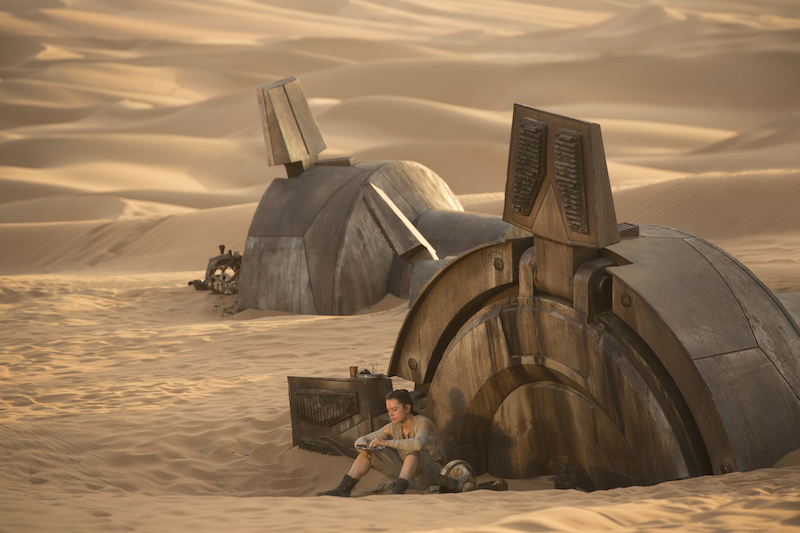
Another reason the prequels needed to happen was to clue Abrams into a fact that expanded universe readers have known forever. It's not just about tossing out the same characters and hitting the same story beats. What people wanted to see all along was more of the incredible world Lucas created, and see more diverse and interesting characters moving around in it. Rather than the plastic, indistinguishable Jedi of the prequels, we're introduced to a genuinely interesting team of characters, all of whom have agency and don't simply exist to drive the plot from A to B. Poe Dameron is the cocky fighter pilot type, Finn is on the path to redemption, and Rey is on the hero's journey to unlock her force powers. Together they have so much chemistry, especially Daisy Ridley's Rey and John Boyega's Finn, whose friendship-maybe more relationship is particularly well done. Also, I think that if anyone says they wouldn't like to buddy up with Poe, they're probably lying.

With that triumvirate complete, they add the crowning glory: Harrison Ford is back as Han Solo, playing the aging smuggler with a great deal more conviction than he did Indiana Jones in his most recent outing. Han snarks at Chewie, blasts stormtroopers and cracks wise like it's 1983 again (or its galaxy far far away equivalent). At the same time, Abrams pulls a beautiful act of inversion and positions Han - the scoundrel, the skeptic - in the role of wise old mentor a la Obi-Wan Kenobi in A New Hope. Harrison Ford's hangdog face really conveys the weight of Han's years and all of the terrible things that went down after the Battle of Endor. It's when Carrie Fisher shows up as Leia, we get to see hints of the old, smooth Han. Really, based on Ford's solid performance in this film I would be happy with him leading the team into the second movie of the new trilogy. But the wise old master role is not without its pitfalls.

So they kill Han Solo. You bastard, Abrams!

In the context of the movie, it makes perfect sense. Han had reached the end of his arc. He embraced the ideal of family, of belonging, which is what the first trilogy was really about for him. He'd been running from his responsibilities pretty much since Ben Solo's heelturn. Walking out on that gantry to confront Kylo Ren AND ENCOURAGE HIM TO EMBRACE THE LIGHT SIDE OF THE FORCE EVEN THOUGH HE KNEW HE WOULD KILL HIM is the most Obi-Wan thing that Obi-Wan never did. I saw it coming, but somehow I was still shocked. Abrams killed Han Solo, but to be perfectly honest, if it were me reviving Star Wars, I'd very likely have gone down the same route, for the same reasons. RIP Han Solo, you'd better return as a force ghost in the next one.

Adam Driver deserves a lot of credit for this scene. When he was cast as Kylo Ren I was nonplussed. But he embodies the conflict of someone struggling against parts of their own nature. Driver is 100 times better at this than Hayden Christensen ever was. I also particularly enjoyed his rage-out when he demolished a console with his lightsaber. He's volatile, emotionally unstable, damaged and unpredictable. Unlike Vader, he actually needs that mask. During the scene with Rey where he removes it, and you see for the first time that he is in fact human - that somehow makes him scarier.

My favourite scene, though, was the final one. Since Luke was always my favourite when I was growing up, and I was waiting for him to show up for the entire thing, very aware by the end he hadn't appeared. When Rey takes the Falcon to Planet Skellig Michael to find him, I thought there was going to be a Return of the King one-too-many-endings thing going on. But instead she climbs the hill, sees Luke, and wordlessly offers him his lightsaber. Bam. Perfect ending. A wonderful emotional note to end on, because Luke looks so broken up by the fact he knows his exile is over. Also, because now he looks just like Alec Guinness did in A New Hope. The whole thing has come full circle. And if Abrams can avoid trying to duplicate frame for frame the original trilogy and just have fun playing in that same, magnificent sandbox, then I think we'll be OK.

ASSORTED MUSINGS:
1) Chewbacca goes freaking mental when Han is killed. It's adorable.
2) Chewie flirts with a nurse.
3) I didn't see a single lens flare in this one.
4) I love how Abrams got the character of the droids, something that was completely missing from the prequels.
5) Check out 3P0 completely cockblocking Han.
6) Has anyone thought about what a Marty Stu Luke is? He's a Space Samurai Wizard Fighter Pilot. That's like a five-year-old's dream resume.
7) If Han was the Obi-Wan in this movie, I guess that means Luke is Yoda in the next.
8) Space Lupita's bar is a worthy successor to the Mos Eisley Cantina.
9) It was fun watching Domhnall Gleason getting his own back on Oscar Isaac for his treatment in Ex Machina.
10) Seeing George Osborne's name pop up in the Special Thanks part of the credits was nauseating. That reptile scumbag pops up everywhere.
11) I want an X-Wing.
12) The re-introduction of the Falcon is lovely, but an awful big coincidence.

In short:


EDIT: Here are a number of other thoughts that popped into my head last night while being kept awake by a screaming infant:
12) Poe and Finn's bromance is so instantaneous it momentarily seems possible the pair might move to the Outer Rim together and herd nerfs.
13) Star Wars was very different from any big tent pole movie these days. At the end of it, one of my first thoughts was "I can't wait to see what happens next!" something I don't ever remember thinking coming out of, say, an Avengers movie.
14) If I can have one more quibble with poorly explained plot - Why is it so important to find Luke? Kylo Ren is obsessed with killing him, so I can buy the First Order looking for him, but why is it so important for the Resistance? Sure, he's a badass war hero, but this is a world where the majority of people still don't believe in the Force.
15) Did anyone else notice Poe and Rey shared no screen time together?
16)  General Hux is about one Demi-Hitler away from Full Hitler during his speech. Spittle everywhere.
17) Did anyone count the number of whoohoos, yeeehoos, or variants thereof?

Tuesday, May 26, 2015

We Are Not (Exploding) Things

I want one of these so much.
*Here be spoilers*

I finally managed to see Mad Max: Fury Road at the weekend, and man, does it live up to the hype - both as a feminist manifesto and a balls-to-wall action thrill-ride. I don't think I can overstate how beautiful I think this film is. It's fantastically shot, the stunts and vehicle design are outrageous, and it is the most - hell, only - emotionally powerful action movie I've seen since Inception.

Lots of people are complaining about this movie. Mostly because they're the sort of people who like to complain about things they don't get. Usually it's Men's Rights Activists moaning that Mad Max is forced to play second fiddle to bunch of slimy girls, and whinging that the film tries to force them to - shock and horror - see said women as equal to men. Or it's traditionalists who are infuriated by the shifting of focus away from Max himself and onto other characters. To be perfectly honest - to my mind - these two arguments are more or less inseparable, but let's address them separately for the sake of fairness.

1) Ugh! Female characters with agency who aren't just there to be damseled or raped!
- Go fuck yourself.

2) This isn't a Mad Max movie. Mad Max isn't even the main character.
- Well, maybe he isn't, and that's a good thing. It's worth remembering that Beyond Thunderdome almost didn't have Max in it at all. It was a completely different story about the kids, and Max was merely inserted in on the suggestion of a producer. So we've established George Miller wants to tell different stories. Does that make him the bad guy here? Max's character arc is already well established. It would be boring as hell if Miller didn't introduce some new, memorable characters.

Speaking as a fan of the first three movies (In order of preference: Road Warrior, Thunderdome, Mad Max) everything about this movie makes perfect sense in the context of the series. Mad Max shows society crumbling, The Road Warrior shows the survivors picking over the scraps, Thunderdome highlights the challenge and pitfalls of rebuilding civilisation, and Fury Road shows us that the greed and messianic entitlement that doomed the world in the first place is alive and well, even in the wasteland.

The film illustrates this point through the juxtaposition of two generations of characters. Immortan Joe, the weakened dictator, obsessed with his own legacy and greedily hogging all of the resources in the wasteland, represents the blind leaders and 1%ers who doomed the world in the first place. Then there's Max, the cynic, for whom "hope is a mistake" and Imperator Furiosa, who says she wants redemption - but revenge might be more accurate. If you contrast those three with Joe's "wives" - who've been through hell but still haven't lost that hope that Max denies - and Nux, the indoctrinated boy soldier, who gets a crash course (no pun intended) in self-determination, you see a beautiful contrast.

That's why the complaints about the feminist ideology of the movie annoy me so much - what holds true for the female characters also holds true for the male ones. "We are not things" says Splendid. The girls, with Furiosa's help, are taking the first steps towards establishing their personhood. Nux, coming face to face with the falsehoods he's believed his entire life does the same thing. And then you have Max, who's been essentially reduced to a thing - as much an animal as the two-headed lizard he snacks on at the beginning of the film. He can't tell Furiosa his name until the dying moments of the film because it's not until then that he truly regains his identity.

This is a theme that we've seen time and time again in the Mad Max movies. In The Road Warrior the grown-up Feral Kid tells us that the wasteland was where Max "learned to live again." All through the movie we see the person he once was fighting to come back to life, from the half-smile that flickers across his face when he finds the music box, to his burgeoning friendship with the Feral Kid and the Gyro Captain. In Thunderdome, we've got an embittered Max, but again, one who risks his life to protect a group of innocents. Mad Max is the story of a survivor. But it isn't water or gasoline that helps Max to survive. It's the kindling of these small flames of hope for a better future that keep bringing him back from the edge.


The Feral Kid approves this message.

Tuesday, May 19, 2015

Fantasy Sucks Episode 1 - The Way of Kings


I've decided I'm going to start doing book reviews on this blog. I figure it's a good way for me to mentally organise myself while I'm doing the first draft of the new novel - if I can figure out here what I like and what I dislike in other people's work, perhaps I can keep on track without descending into to my habitual 7-year timeline of endless plot revisions. I'm not George R.R. Martin. This isn't a new Guns N' Roses album. If I'm going to make this work for me as a job (obviously not my only job) I'm going to need to be finishing a 100,000 book every 12-18 months. Of course, I should really concentrate on selling the one I've got, but that's another story. In the meantime, my new strategy is to have a clear idea of what I'm doing before I start, and then just write it.

Which brings us to The Way of Kings, which is a phenomenally successfully fantasy novel by Brandon Sanderson. Since I'm trying to write a phenomenally successful fantasy novel, this seems like a good place to start, right?

I have to admit being a bit slow in picking up this first volume in the Stormlight Archives series. I also have to disclose this belated review is perhaps coloured by the considerable sprain in my hand from carrying this BRICK of a novel around with me everywhere for the last couple of weeks. And it is an immense book, clocking in at around 1,000 pages, acceptable for a fantasy author but damn right unforgivable for anyone else.

The length is one of the main problems I have with this book. There are three main perspective characters: Kaladin, a surgeon's son forced into slavery; Dalinar, brother to the murdered king, who is plagued by strange visions; and Shallan, an apprentice scholar trying to steal a valuable artifact. The problem is that these three stories are spread out over 1,000 pages and don't really go anywhere. Sure, Kaladin wins his freedom at the end of the book after gallantly rescuing Dalinar, but Dalinar's visions are left unresolved, and Shallan's theft - when it does come off - doesn't really lead to anything.

Any good editor would have cut half of this book. Half. 500 pages.

It's not like there's a tremendous amount of world building that goes into Sanderson's world, either. Sure, we get a sense of the different nations, different cultures - that stuff is actually very well done - but really there are only two locations we see in any depth, the warzone of the Shattered Plains and the city of Kharbranth (the former much more than the latter, since that's where two of the three protagonists are located).

My beef is that the character's arcs are unnecessarily convoluted. Kaladin - who it seems is being set up for a tropey sort of 'chosen one' arc - begins as a defiant slave, fails to escape a bunch of times, then experiences a loss of hope. Then he has a change of heart, and decides to help save his team of expendable "bridgemen". Unfortunately, then he has another change of heart and spends about a quarter of the novel moping about how it's all pointless. Somehow, the men who now follow him still look up to him, and when he finally decides to care again he throws away their escape plan to help Dalinar, who rewards them by making them his personal honour guard. Suspending disbelief for a moment that bunch of malnourished slaves who had never held a spear before could fight better than regular soldiers, there's a long wait in this story for very little in the way of payoff. Kaladin's attitude to his plight is up and down like he's riding an emotional pogo stick.

Likewise Dalinar's story. In the beginning, he's suffering from apocalyptic visions, which he doubts. Over time, he comes to believe there might be something to them. Then he abruptly changes his mind and decides to abdicate in favour of his son. Then he changes his mind again, and decides not to abdicate. Then his visions are proven to be true, but misleading. So he ends up in the same place he started, wracked with doubt. The visions aren't explained, except that they come "from the Almighty" (I didn't know that Sanderson was mega religious until I read his wikipedia page today, but it makes sense given the world he's created, and the vaguely messianic implications of Kaladin's storyline).

In addition, the plot twists (with the exception of one, which came out of nowhere) are too predictable. Although we don't see the reason for Kaladin's enslavement until the final chapters, by the time we get there the reader has likely already figured it out. The same with Shallan's "crime" that she continually alludes to. By the time she says it out loud, you've already known for quite some time.

There are bright spots though - the fight scenes, of which there are many, are an utter joy. The concept of Shardblades and Shardplate - essentially semi-corporeal mythic weapons so powerful that they can allow one warrior to literally turn the tide of a battle - is intriguing and Sanderson has a lot of fun with it. There's certainly a lot of poignancy to Dalinar's disgust at his own actions in battle, using his super-powered armour and sword - which basically turn him into a human tank - to slaughter hundreds of enemies at a time. The best though, is the gravity-flipping magic used by the assassin, Szeth. Epic fights are even more epic when they are performed on the ceiling, or when they involve flipping large boulders into your adversaries by simply persuading the rock that down is that way.

Will I come back for the second volume in the series? I have to say, I might not, and my OCD rarely allows me to neglect reading an entire series. I guess I'll have to read some reviews and see if the characterisation problems have been ironed out. What I'm really concerned is that Sanderson might have ruined the Wheel of Time, a series I genuinely do enjoy, for all its faults. Time will tell, since there are like 800 books and I'm only one book four.

Saturday, January 31, 2015

I formally resign from Dark Souls

Alas, poor Cuthbert. I knew him well.


I quit Dark Souls. I quit. I quit. I quit.


I missed it when it came out, and to be honest, I wish I'd left it missed. I heard it described as "the most rewarding gaming experience ever" and that piqued my interest. I wish that statement had been qualified with "it's the most rewarding gaming experience ever if you are the sort of person who watched that bit in the Shawshank Redemption when Tim Robbins pulls himself through several miles of sewer pipe and comes out in the rain on the other side and thought to yourself 'wow, that looks rewarding.'" I get it. I get that beating a hugely difficult game will make you feel like a champ. But is that feeling worth all the suffering and horror to get there? Like, I imagine prosecuting the guy who murdered your wife feels pretty good, but at the end of the day you probably would trade that feeling for just not having your wife murdered in the first place.

I did not play Dark Souls for very long. Maybe a week. Less, probably. I got as far as the second bonfire in the Undead Burg, before I flipped my lid and turned it off, probably forever. I enjoyed my character, Cuthbert, a snooty cleric with a ginger bowlcut. I didn't even mind the fact he took hit after hit, because in my mind it was all part of the character. I was looking forward to turning him into a sort of paladin-type with cool miracles and perhaps a sword. Maybe a halberd (I dig polearms and you don't get to use them in many games).

But after two days of being killed mercilessly and going back to that same fricking bonfire, I could take no more. It wasn't that gigantic Black Knight that kept killing me that did it, or those awful guys with spears. It was those assholes with the firebombs. Something seemed to snap in the game after a while and I was no longer able to sneak up on them. No matter where I moved they were always facing me and I couldn't get close to them without being incinerated. And these are the easiest bad guys in the game?

No. Fuck that.


It's not that it's the hardest game I have ever played. Hard is fine. I like hard. I'm the kind of guy who plays RPGs with the weapons their character is worst with just because I get bored of kicking too much ass. It's not that the game is unfair, because it isn't. If you knew the tricks for defeating every enemy, it would be possible to make it through every level unscathed without dying once. But you would have to be fucking Taskmaster with perfect muscle memory to do it. I don't mind dying. In fact so many of the deaths in Dark Souls are actually hilarious - I got filleted by ghosts, mashed by a completely unexpected boulder, hammered into a paste by a giant demon - I enjoyed them. But constant trivial death at the hands of the most banal enemies? I just can't handle that.

I think it will just get worse as the game goes on, and just be harder to quit. So, here it is, Dark Souls. We're just not good for one another. My life doesn't fit you. In another time, perhaps, when I was determined and obsessed with my Csports ranking and I had no wife and toddler and jobhunting and novel writing, perhaps I would have persevered and beat you. Perhaps I would brayed and whooped at your defeat. But that's not who I am now.

I reckon I probably get two hours a week of videogames. Gaming is almost a Taoist experience for me. It's the only time in my life when I am not thinking, planning or plotting. I even do it in my dreams. But gaming is when I am truly able to switch off. I'd rather those times were spent with enjoyable experiences rather than confounding and irritating ones.

I don't usually quit games. The only one I can think of offhand that I did quit was GTA IV, because it bored me. I will play any game through to the end, so long as I'm enjoying it. But if I don't enjoy it, then why play? What is this, sports?

So, yeah, that's me. I'm downloading Kingdoms of Amalur now because it was $3.99 on Xbox Live, and it was on my list anyway.

I don't even feel like a massive failure. It's Dark Souls fault for being the videogaming equivalent of some Japanese game show where you have to eat a tarantula while being shot in the gonads with a paintball gun.

Friday, August 29, 2014

The Mass Effect trilogy postmortem

Phineas Shepard, presumably making a tough call
This article contains endemic spoilers for Mass Effect 1, 2 and 3.

I finished Mass Effect trilogy a couple of weeks ago. Yes, I know that you all did that in 2012. I, as many of you will know, spent two years in Japan without a console and as such am two years behind on games. This works in my favour because I usually end up getting them cheaper, often as Game of the Year editions with included DLC and suchlike. But on the other hand, I have to put up with people going on about the newest and best games and know I have two years of games to play before I get there.

Anyway, I will confess to feeling emotional and a little conflicted about the end of my beloved Mass Effect. I have long championed the franchise as a classic example of how games can match and even surpass film and TV in terms of characterisation and pure storytelling power. The ME games were popular primarily because they created a game world with memorable characters that you actually cared about. Some of the franchise's most powerful moments weren't running around and shooting aliens (although there was a fair amount of that), but - for wont of a better word - drama.

I had played ME1 and 2 before, but on different machines, meaning I had lost the save files. This meant that my previous characters - the swaggering Leonid Shepard, who looked like a thick-necked Kyrgistani, and the crotchety Apollonius Shepard, who resembled a melted Bradley Cooper - were a no go. So I decided to play 1 and 2 again to build up my character so that I would get the full impact of the series' finale in 3. This entire process took me a little over nine months (I don't get much time to play videogames anymore).

For this definitive playthrough, I named my new Shepard "Phineas" and chose the infiltrator class, knowing from experience that it was crap in ME1 but looking forward to using the invisibility cloak in the later games. For Phineas, I had in mind a grizzled commando type who had clearly seen a lot of shit. I also knew I didn't want to be the galaxy's White Saviour, so I made him a delightful golden brown, with a shaved head and stubble. He looked a bit like a mix between Common and Keanu Reeves, or from certain angles Nicolas Anelka. I chose Earthborn and Sole Survivor for his background. I played Phineas as more or less a straight up paragon, but enjoyed engaging in unexpected acts of roguishness once in a while. For the romance, I chose Liara because nerd chicks.

Badass.
Lets talk a bit about the characters here. This is the only game I have ever played where the majority of secondary characters actually have sensible and well thought-out character arcs. You can actually see the characters grow and develop over time. Take for instance, everyone's favourite wingman, Garrus Vakarian. In the first game, Garrus was a stickler for the rules, crying foul when Wrex casually dispatched a gang boss in front of him, reminding everybody to stay hydrated. His big epiphany in the first game was realising that sometimes in order to preserve the law, you have to break the rules. In ME2, drummed out of the Alliance with the rest of the alien members of the Normandy's crew, and with no C-Sec to go back to, he goes to the most crime-ridden, sin-infested station in the galaxy and essentially becomes Batman, taking the whole "renegade" thing to the extreme. By the third game, we see Garrus taking up a position of responsibility in the Turian hierarchy while simultaneously refusing to conform, and making his father proud. In addition, one of the most touching elements of the games where watching Garrus and Shepard's friendship develop into one of videogaming history's finest bromances (or creepy giant insect/lady romance, if you're so inclined). If you could go drinking with one videogame character, let's face it, it would be Garrus.

Throughout the course of the game, you see your teammates growing and maturing. You bring Tali on as a naive young girl, and over the course of her arc she is disgraced and virtually exiled from her people before redeeming herself and taking a central role in reclaiming the Quarians' home planet. I always found her to be something of a spunky little sister, and particularly enjoyed her scenes. Her getting together with Garrus at the end was sweet but more than a little bit creepy.

Kaidan is another character who comes a long way over the course of the story. In ME1 he's a socially maladjusted whiner that I only saved because I needed someone with biotics and a shotgun, and Ashley's space racism was grating on me. In 2 he's just self-assured enough to tell Shepard he thinks he's making a huge mistake in working for Cerberus, and by 3 Kaidan is a Spectre himself, and treats Shepard almost as an equal. Some of the scenes with Kaidan are made slightly awkward by the game developers assuming that because I didn't leave him for dead on Virmire I obviously wanted to hit that, but I can forgive them. Nothing is perfect. Oh, Kaidan gets an extra shout-out for being Canadian.
Goodbye forever, space wife!

On the other hand, though, in some of the arcs you can see Shepard's influence becoming something a little bit scary. Liara's character arc was a favourite of mine, although I feel that without the Lair of the Shadow Broker and From Ashes DLCs, it would be a little bit lacking. Another innocent when brought on board the Normandy, Liara is a nerd with poor social skills. She constantly puts her foot in her mouth, and it's kind of adorable. In ME1 She deals with the indoctrination and death of her mother with classic stiff upper lip, but for her the mission is never anything less than one of scientific discovery. Eventually, she abandons her purely philanthropic scientific ideals in favour of the power of becoming the new Shadow Broker. She basically manipulates Shepard into helping her, when it's clear that she was after after the Broker's job all along. It's an unnatural move for her, and you can't help but think Shepard has led her astray by involving her in the battle against the Reapers. Even with that quest  to keep her honest, it's still a huge amount of power heaped on a relatively young pair of shoulders, and a couple of times when she's threatened to psychically flay informants you start to think she might have a dark side. Liara gets some good scenes showing just how she's changed between the first and second installments in Lair of the Shadow Broker, and the part in which Shepard confronts her about their relationship is actually very well-written. She doesn't just fall into your arms (not until she gets what she wants, anyway). When she's introduced in ME3 there's a slightly chilling moment when she immobilises a Cerberus trooper with her biotics and then walks over and casually shoots him in the head. That's not the anxious lab rat that you brought on board in the first game. That's someone much scarier. And you have to live with the knowledge that you did that to her. Truthfully, I'm going to miss Liara.

Some of the lesser characters who were on the team for shorter periods deserve mention. I really liked James. To begin with, I thought he would be another muscle-bound grunt, but instead he turned out to be a big sensitive teddy bear with idiosyncratic habits and killer recipe for heuvos rancheros. Mordin the oddball scientist with his mish-mash of religious beliefs and love of musical theatre. EDI subverting the usually boring "robot becomes human" storyline with a hearty dose of humour. Legion, Shepard's robotic stalker. These were GOOD characters. More good characters than any one franchise had a right to.

So, what of the ending? Unlike most of you playing it for the first time two years ago, I had the extended cut from the get-go, so my ending more or less made sense. I botched it the first time, because I wanted to go for the Destroy ending but accidentally went to the wrong panel and chose Control instead. Was this a good ending? Shepard makes the ultimate sacrifice, and gives up his life to essentially become the force that drives the Reapers, using them to help rebuild the galaxy. Although the idea of the heroic Shepard watching over us for all eternity and protecting us from evil is a comforting one, it gets a little freaky when you realise Shepard is essentially going to be policing the galaxy and eliminating free will, because it inevitably leads to conflict. In essence, he's just picked up the same BS job the Reapers were created for in the first place, with the same limited set of options for dealing with the galaxy's problems. How long until he's harvesting planets, I wonder? We'll see what a few centuries inside the collective mind of a bunch of immortal machines does to his finely developed sense of fair play.

I was annoyed I had picked the wrong option, so I went back and played the final level through again. This time I picked destroy. I wish I had picked it the first time because now I can't really see this as the 'canon' ending for my Shepard, even though it's what I would have picked if I'd paid more attention to which panel did what the first time round. Because the end sequence is virtually the same as Control, it wasn't much of a payoff. But wait! Who's this lying in the rubble, N7 dogtags round his neck? HE BREATHES! I'd luckily picked up enough points along the way to get Shepard out alive. I wouldn't want to speculate on what condition he's in (going to need a LOT of reconstructive surgery - luckily I paid for that advanced med bay on the Normandy) but he will live to retire and hopefully father some little blue babies. I think that would make him happy.

One question about the destroy ending: what happened to the Geth? The Catalyst said the beam would target all synthetics, so did my army of friendly sentient robots get destroyed too? I hope not, because that would be something of a betrayal.

So many thoughts. This game is going to stay with me for a long time. I am already looking forward to ME4. I just hope they give you a bit more freedom with character creation. I'd love to play as a Turian or Asari.

Some moments I loved:

1. Shepard decks Saren (ME1)
 On Virmire the erstwhile Spectre Saren Arterius gets a little too close, and Shepard gives him a knuckle supper. Classic Shep.

2. Shepard reassures Garrus he's still pretty (ME2)
After almost dying on Omega, Garrus has got a few more scars. Does Shepard politely downplay them? No, he tells Garrus not only is he hideous now, but he was always hideous. As all bros should. Somehow that's the right thing to say. 

3. Liara shows Shepard his legacy (ME3)
Liara and Shepard get a nice moment together that doesn't lead to sex for a change when Dr. T'Soni comes round to show the Commander her science project.

4. Liara flips out at Javik (ME3)
After the fall of Thessia, Liara does something she's never done before: flip out. The target of her wrath is Javik, the disappointing Prothean. Deal with the situation by ripping them both a new one. It's best for all of us that way.

5. Kaidan and Shepard argue on Freedom's Progress (ME2)
Kaidan actually made me feel a little ashamed of myself here. It hurts that an erstwhile member of your crew thinks you're a traitor.

6. Shepard and Garrus shoot first (ME2)
If you can't be bothered listening to the villain's monologue, pop his guards and get on with roughing him up. He'll never expect you to be that impolite.

7. Anderson's goodbye (ME3)
"You did good, son." Keith David, you have made me cry.

8. "That was a joke." (ME2)
Poor Joker's face when EDI tells him she likes seeing organics kneel before her.

9. Shepard's renegade speech on the Collector base (ME2)
This is the best speech in the trilogy. To cut a long story short, Shep essentially declares he's tired of the Collectors' bullshit and they're going down.

10. Shepard tells the Illusive Man to go fuck himself (ME2)
The grin on his face when he turns the comms off says "this is why I get out of bed in the morning."

11. Mordin sings Gilbert and Sullivan (ME2)
Self-explanatory.

12. Shepard escapes the Collector base (ME2)
I hate slo-mo jumps, but this one made me cheer.

13. Liara is injured and airlifted out (ME3)
 This was added in the extended cut, and I don't know what the moment would have been like if it hadn't had my love interest in my party, but it was absolutely harrowing to see Shepard and Liara torn apart there, knowing it would likely be the end of their story.

14. James flirts with Tali (ME3)
"Sparks. Because of the sparks in your... ah, forget it."

15. Drunken Tali mourns Miranda (ME3)
Drunk Tali is always a win. This one was poignant, though, because I'd just lost the first crew member that I knew I *could* have saved.

16. The Normandy takes down Sovereign (ME1)
The original fuck-yeah moment from the first game. When the Normandy swoops down and takes out Sovereign, that's when Joker gets his badass card.

17. ALL THE SHIPS (ME3)
When your assembled fleets arrive in ME3. That's a lot of ships.

18. Wrex flirts with Liara (ME3)
When Wrex shows another side of himself and puts the smooths on Liara. Hey! She's taken, dammit! Whose ship is this?

19. Liara tells Shepard she would like to dissect his brain (ME1)
And true love blossomed.

20. Shepard gets poisoned by Forvan (ME2)
Let's not forget the time a Batarian bartender roofied Shepard, but when he woke up he forced the bartender to drink his own concoction until he died. It's not a Normandy party until you've poisoned a Batarian. Ha ha. Classic Shep.

Saturday, September 14, 2013

Benedict Cumberbatch

Benedict Cumberbatch
Beg-a-trick Bumperthatch

Bendydick Bumberklunge
Burningprick Cobrabite
Tennis-stick Dolomite
Renegade Thunderminge
Benzedrine Flick-a-switch
Penetrate Hyperwitch
Ten-a-day Plumbershop
Penniless Klumpyshoes
Verythick Herringcatch
Bag-of-tricks Murderbot


Monday, May 20, 2013

The True Classes of Britain

Psychotic Plutocrat

You have a six figure salary and a luxury home, but have wangled it so you pay as little tax as an unemployed single mother of five. You work in financial services or the legal profession. You are highly educated, and keenly aware of your innate superiority to regular Britons, who you prefer not to think about. You enjoy the finer things in life, expensive dinners, single malts, tailored clothes. You are often found humiliating sex workers.
You are adept with technology, as comfortable with a digital camcorder as you are with compressed-air nailgun. You buy an awful lot rugs, and more tarp. You remain emotionally detached and in the course of your work routinely ruin people's lives. The only time you allow an outpouring of emotion is when a former Conservative Prime Minister or major Royal dies.
You are the least likely social class in Britain to stop if they ran someone over, and the class most people wish they were. The gap between rich and poor being what it is, you also have less in common with average people than any other class in Britain. That is, with the exception of the Urban Marauder, with whom you share a penchant for setting fire to tramps.

Tax Workhorse

Congratulations, you are a member of Britain's shrinking middle class. This means you must shoulder the burden of paying for both the wily Plutocrats and the workshy poor. Don't worry, though! It's almost impossible that you will get through your life without having some form of breakdown, as corporate cost cutting trims your coworkers down to the point where you are effectively doing six people's jobs for one salary.
You commute so much you effectively live in your car. You spend little time at home, and all of that is spent sleeping. Honestly, you might as well live in a shed. You'd never know the difference. But where would you keep your family? Oh, you have a family? I didn't know. But do you really? When was the last time you saw them? I probably know them better than you do. Take a look at your daughter's brazen Facebook selfies! Do you think she's sexually active? Here's a clue: she is.
You will live out your life with a feeling of ennui that no holiday, big ticket electronics purchase or new car can ever erase. You will always feel you're being taken advantage of, always feel you're being laughed at. Well, you are.
All of your hopes will turn to ash and your brain will seize up and explode on the day you retire. Your daughter will use your savings for a boob job.

Mediocrity

Everything about you is bland. Your interests are pedestrian and your opinions barely formed. You probably like TV or a sport. Chart music is aimed at you, and you buy a CD once a year from Asda - this business model only works because there are so many of you.You probably haven't given it much thought, but your only purpose is to consume goods to keep Britain's stumbling retail and service sector afloat. You are the kind of person who eats at TGI Friday's and likes movies with Sam Worthington.
You are the happiest social class. Here is a tax rebate. Go and spend it on a G-Star Raw t-shirt and another meaningless tattoo of a star.

C-list Celebrity

You want to be famous, but you aren't. At least, not yet. Frustratingly, you might already actually be a "media personality" except no one knows who you are. Perhaps you've appeared in Essex Girls in the Jungle or Fuck Up My House Please, but it isn't delivering the level of super-stardom you expected. There are only three ways to fix this: getting horrendous plastic surgery, a sex tape or killing someone more famous than you.

Urban Marauder

You live every day like it is the last. In your case, this mostly involves driving a car through the window of your local Aldi and putting its inhabitants to the sword. When you're not pillaging, you can usually be found enjoying one of the local varieties of hard drugs, because if there is no future, there's no need to worry about the consequences, right?
It would be a mistake to think you're not creative, though. Could a mediocre mind come up with taping a Stanley knife to the head of a hammer?
Essentially, you are living the life of a post-apocalyptic land pirate now, and for that you should be admired, if not applauded. Please don't kill me.

Saturday, March 02, 2013

Can you believe Ubisoft failed to hire me as a games writer?

 Who could ever want to kill these guys?

I applied for a writer job a couple of years back with Ubisoft. Of course, with my complete lack of game writing experience, references, connections, or any verifiable talent, I didn't even get an interview. But in a way, having just completed Far Cry 3, I can't help but feel the joke is on them.

Yes, yes, we've all read the endless criticism of Far Cry 3 for being racist, tropey and full of poorly drawn characters. We might even have read the bullshit excuses that the writer pulled out of his ass, claiming that his writing was deliberately shoddy because he was "subverting video game cliches." Subverting how? Does revelling in cliche after cliche somehow make it new and exciting? I mean, this guy even claims that half of the stuff that was going on in the game was in Jason's mind. Yeah, I must have missed that. Failed to land that one, mate.

He describes Jason as an "unreliable narrator." Which would be fine, except that we see everything through Jason's eyes, and there is no indication that anything that anything that is happening on the screen is, well, not happening. If there was, it would raise a few questions - for instance, how can something that is not real have real consequences? Didn't I die every time I tried to wingsuit into that cliff cave outside Gaztown to get that relic? If it was all made up, then why did I die? Where was the threat from my enemies? It negates the whole experience. This is a videogame, not The Catcher in the Rye.

I started out the game enjoying bushwhacking my way through the jungle, haphazardly slaying pirates. I didn't even mind Dennis and his Bagger Vance act so much. I thought the friends were a bunch of douchebags - hell, even Jason was a douchebag - and having read a couple of spoilers about the ending, quite frankly couldn't wait to murder them all.

Just fuck off.

But then I met Citra. Sweet Jesus, Jason must be riddled with hepatitis now. I would hazard I have never met a more annoying character in any videogame. And the writer apparently wishes us to believe she is deliberately annoying? Now I just feel like he's fucking with me for the sake of it. That was when the game went downhill.

There were plotlines that I enjoyed, only to find them cruelly dashed. The letters found on the dead Japanese soldiers - provided you didn't stop to ask how the hell can Jason read Japanese - were intriguing, but you collect them only to find the last four documents, which would surely have revealed all, have been erased by yet another douchebag with nonsense about a grenade-toting monkey. Yes, writer, I see what you are doing here. You are subverting our expectations, but why do it when this ultimately leaves us unfulfilled? Why did I bother collecting all those items? It sure as shit wasn't so you can rub how smart and postmodern you are in our faces.

And the Chinese captain and the glowing knife. OK! You've drawn me in now, except it doesn't come to anything except a knife fight with a rapist, despite the fact that this plotline CONFIRMS THE EXISTENCE OF GENUINE CHINESE MAGIC. And what consequence does it have? None at all.

In fact, the only two likable characters in the game were Buck and Vaas. One is a rapist hitman and the other is a psychotic killer. And I stabbed both of them to death. At least, I stabbed Buck to death for sure. As for Vaas, since it happened in some messed up dream sequence I can't even say I did. Yes! Yes, the writer crows! I subverted you! I'm subversive! I made goodies so awful you actually prefer the baddies! Yeah, well, but since both of the non-irritating characters are dead about 60% through the game, you still have 40% of it to go, with only some unbearable pricks for company. One is a German who somehow was also in the U.S. Marines and yells BLITZKRIEG! as he goes into battle. That's some lazy shit right there.

This isn't at all to belittle how much fun the game is, because I would be lying if I said that I didn't have an immensely good time machete-ing people then killing their friends with their own sidearms. I truly had some excellent gaming experience, including a massive, 40 man gunfight that resulted from a simple traffic accident, and that time I cleared a base by SETTING THE ENTIRE JUNGLE ON FIRE! PRAISE BE TO THE RED GOD! Apart from the tacked on side missions which they just should have skipped ("Hey, there are three artifacts that have been lost for 1000 years! They're all within 100 yards of here and marked on this map! Can you go collect them for me? No, there are no threats between here and there. I'm just too lazy to do it myself.") it was, up until the novelty wore off in the third act, a very enjoyable game, that is when you weren't doing 'story' missions.

I'm an intelligent guy, OK. I read. I have a literature degree that is largely useless EXCEPT for deconstructing narratives like this. I'm pretty much the target audience for smart video games. And I am telling you now, if I don't objectively see the genius of Far Cry 3's plot, then it's not because I'm too dumb to understand it, as the writer argues, it's because the genius just isn't there. Would I have done it differently? Probably. I wouldn't have fallen into the first-year creative writing student trap of turning a simple narrative in a limited medium into a self-parodying, too-meta-for-its-own-good fuckupalypse. The whole thing left me fealing teased and kind of insulted.

But I paid $50 for it, so I had to play it to the end, even though that last knife fight with Hoyt was hard, and had no checkpoints in it, meaning I had to listen to the same SHIT DIALOGUE AGAIN AND AGAIN EVERY TIME I DIED.


At the end of the day, the oppressive awfulness of Citra filled me with such foul temper, I leapt at the chance to leave the island. Dennis stabbed her and she died cheesily proclaiming her love for me, while I screamed at her to shut up and die so I could go to bed. So yes, I chose the douchebag friends. Because, when the final curtain came down, they were the characters I identified with most. Abused and persecuted, they just wanted the ordeal to be over. And in the end, so did I.